
Gas detection is a critical component of industrial safety. Whether you’re monitoring flammable gases, toxic substances, or oxygen levels, selecting the correct gas detection technology is essential to ensuring reliable performance and effective hazard mitigation.
However, there is no one-size-fits-all solution.
Every gas behaves differently and possesses its own physical and chemical properties. Because of this, different sensor technologies are required to detect specific gases accurately and reliably. Choosing the wrong technology can result in reduced performance, increased maintenance costs, nuisance alarms, or even complete detection failure.
Understanding the strengths and limitations of each sensing technology is therefore an important step when designing a fixed gas detection system.
Why Detector Selection Is Essential in High-Risk Environments
The consequences of selecting the wrong gas detection technology can be significant.
Complete Detection Failure
Different sensor technologies are designed for different applications. For example, a catalytic sensor intended for flammable gas detection would not be suitable for monitoring carbon monoxide. If the wrong technology is specified, hazardous gases may go completely undetected.
False Sense of Security
A functioning gas detection system may appear to be providing protection, but if it is unable to detect the target gas, dangerous concentrations can accumulate without warning.
False Alarms and Alarm Fatigue
Poor technology selection can increase the likelihood of nuisance alarms. Over time, frequent false alarms can contribute to alarm fatigue, reducing confidence in safety systems and potentially delaying responses during genuine incidents.
Sensor Damage and Reduced Performance
Certain sensor technologies can be affected by exposure to contaminants or chemicals for which they were not designed. This may lead to reduced sensitivity, increased calibration requirements, or premature sensor failure.
Legal and Operational Risks
Employers have a responsibility to provide suitable safety measures for hazardous environments. Inadequate gas detection can increase operational risk and may lead to non-compliance with workplace safety requirements.
Different facilities operate under different conditions, which is why understanding the available technologies is essential when selecting a gas detection solution.
Catalytic Bead Sensors
Catalytic bead sensors are one of the most widely used technologies for detecting combustible gases. They are commonly used to monitor gases such as methane, propane, butane, and hydrogen, typically as a percentage of the Lower Explosive Limit (LEL).
How Do Catalytic Bead Sensors Work?
A catalytic bead sensor contains two heated elements: an active bead and a reference bead.
- An electrical current heat both beads to approximately 450°C.
- When a flammable gas reaches the active bead, a controlled oxidation reaction occurs on its surface.
- This reaction generates additional heat, increasing the temperature of the active bead.
- The reference bead remains unaffected by the gas.
- The difference in resistance between the two beads is measured and converted into a gas concentration reading.
The output is proportional to the concentration of combustible gas present in the atmosphere.
Benefits of Catalytic Bead Sensors
- Detects a wide range of combustible gases
- Proven and widely adopted technology
- Cost-effective solution for flammable gas detection
- Performs well across a range of operating conditions
Limitations of Catalytic Bead Sensors
- Requires oxygen to operate correctly
- Can be affected by catalyst poisoning or contamination
- Regular calibration is required
- Typical sensor lifespan is around two to three years depending on the application
Infrared (IR) Gas Detectors
Infrared gas detectors use optical technology to measure the amount of infrared light absorbed by gas molecules.
They are particularly effective for monitoring hydrocarbon gases and carbon dioxide and are commonly used in fixed gas detection systems across industrial environments.
How Do Infrared Gas Detectors Work?
- An infrared light source projects light through a sampling chamber.
- If target gases are present, they absorb specific wavelengths of infrared energy.
- The remaining light passes through optical filters before reaching detectors.
- One detector measures wavelength affected by the target gas, while a reference detector measures unaffected wavelengths.
- The system compares both signals to determine the gas concentration.
The dual-beam design helps maintain accuracy by compensating for factors such as ageing light sources and environmental changes.
Benefits of Infrared Gas Detectors
- Immune to catalytic poisoning
- Long operational life
- Low maintenance requirements
- Can operate in oxygen-deficient environments
- Fast and reliable response
Limitations of Infrared Gas Detectors
- Higher initial purchase cost
- Unable to detect some gases, including hydrogen
- Performance varies depending on the gas being monitored
Electrochemical Sensors
Electrochemical sensors are widely used for toxic gas monitoring and oxygen detection.
They provide highly accurate measurements at low concentrations, making them ideal for applications where personnel exposure limits are critical.
How Do Electrochemical Sensors Work?
- Target gas enters the sensor through a permeable membrane.
- The gas reacts at the surface of an electrode.
- The reaction generates an electrical signal.
- The signal is measured and converted into a gas concentration reading.
The magnitude of the electrical response corresponds directly to the concentration of the target gas.
Common applications include monitoring:
- Carbon monoxide (CO)
- Hydrogen sulphide (H₂S)
- Chlorine (Cl₂)
- Sulphur dioxide (SO₂)
- Ammonia (NH₃)
- Oxygen (O₂)
Benefits of Electrochemical Sensors
- Highly sensitive at low gas concentrations
- Excellent selectivity for target gases
- Low power consumption
- Suitable for toxic gas monitoring
Limitations of Electrochemical Sensors
- Finite sensor lifespan
- Can be influenced by environmental conditions
- Potential for cross-sensitivity to other gases
Ultrasonic Gas Detectors
Unlike conventional gas detectors that wait for gas to reach a sensing element, ultrasonic gas detectors identify leaks by detecting the high-frequency sound generated when pressurised gas escapes from containment.
These systems are particularly effective for detecting high-pressure gas releases in open or well-ventilated environments.
How Do Ultrasonic Gas Detectors Work?
- Pressurised gas escapes through a leak point.
- The rapid pressure change creates turbulent flow and generates ultrasonic sound.
- Acoustic sensors detect frequencies typically between 20 kHz and 100 kHz.
- The detector analyses the acoustic signature to determine whether a gas leak is present.
- An alarm is generated if predefined thresholds are exceeded.
Because detection is based on sound rather than gas concentration, leaks can often be identified before a gas cloud develops.
Benefits of Ultrasonic Gas Detectors
- Immediate leak detection
- Effective in outdoor and windy environments
- Does not rely on gas accumulation
- Can support early fault identification
Limitations of Ultrasonic Gas Detectors
- Requires pressurised gas systems
- Detection depends on line of sight
- Does not provide gas concentration measurements
Key Factors to Consider When Choosing a Gas Detection Technology
Selecting the correct gas detection technology involves more than simply identifying the target gas.
Gas Type
The nature of the hazard should always be the starting point. Flammable, toxic and oxygen-related hazards often require completely different sensing technologies.
Environmental Conditions
Temperature, humidity, airflow, dust levels and installation location can all affect detector performance and should be considered during system design.
Response Requirements
Some applications demand the earliest possible indication of a leak, while others prioritise concentration monitoring. The required response strategy can influence technology selection.
Maintenance Requirements
Calibration intervals, sensor replacement schedules and ongoing servicing requirements all contribute to the overall cost of ownership.
System Integration
Modern facilities increasingly integrate fixed gas detection systems with fire and gas systems, ventilation controls, emergency shutdown systems and building management systems. Choosing compatible technologies helps create a more effective safety strategy.
Choosing the Right Technology
There is no single gas detection technology that is suitable for every application.
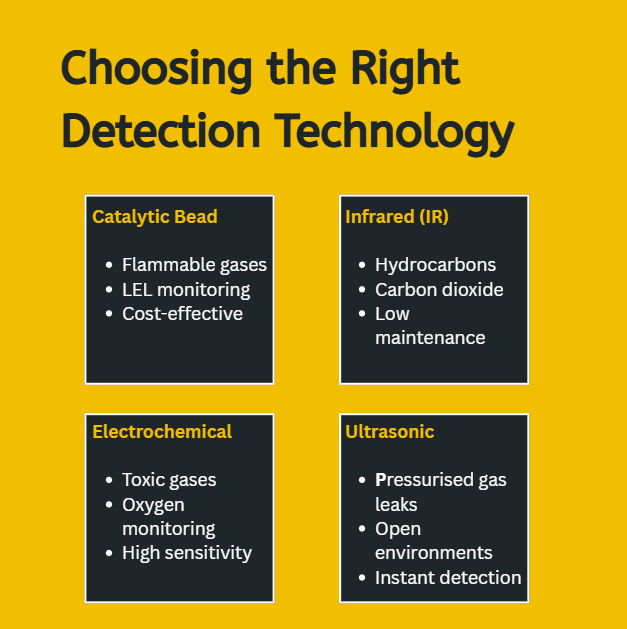
Catalytic bead sensors provide proven combustible gas detection. Infrared detectors offer reliable hydrocarbon monitoring with reduced maintenance requirements. Electrochemical sensors deliver accurate toxic gas and oxygen monitoring, while ultrasonic detectors provide rapid leak detection for pressurised gas systems.
Understanding the strengths, limitations and ideal applications of each technology is essential when designing an effective gas detection strategy.
At Protex Systems, we work with organisations across a range of industries to specify, install, commission and maintain fixed gas detection systems tailored to their operational requirements. By selecting the right technology for the right application, businesses can improve safety, support compliance, minimise downtime and strengthen long-term operational resilience.


