
The AI industry is experiencing rapid growth, driven by significant investment, increasing enterprise adoption, and the continued expansion of AI systems worldwide. Industry analysts project the Artificial Intelligence market to grow at a compound annual growth rate (CAGR) of approximately 25-30% over the coming years. As AI adoption continues to accelerate, the demand for AI data centres is growing alongside it.
Technology companies such as Amazon, Meta, and Microsoft are investing billions into AI infrastructure and hyperscale data centres to support increasingly powerful AI applications. This growth is placing significant pressure on energy infrastructure, with electricity consumption from data centres expected to rise substantially over the next decade.
As AI workloads become more demanding, ensuring these facilities have access to reliable, resilient, and safe power systems is becoming a critical challenge.
Why Do AI Data Centres Require More Power Than Ever?
AI data centres require significantly more power than traditional data centres due to the intensive workloads associated with training and running large-scale AI models. Unlike conventional data centres that primarily manage web traffic, cloud storage, and business applications, AI facilities rely on dense clusters of high-performance hardware operating continuously.
Key Drivers Behind Growing Power Demand
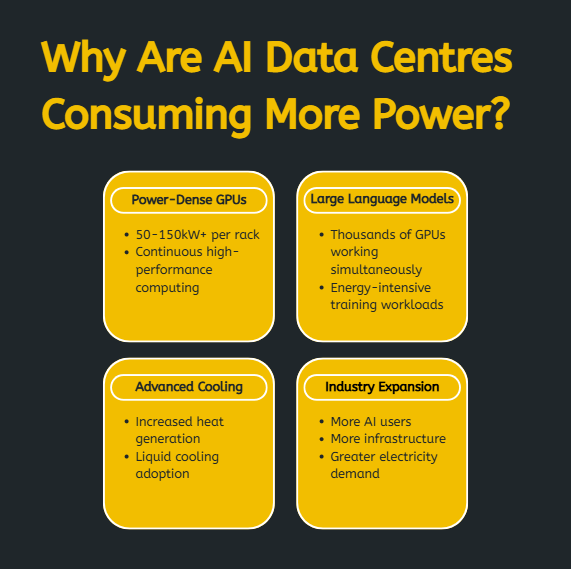
Power-Dense Processors
AI workloads rely heavily on Graphics Processing Units (GPUs) and specialised accelerators designed to perform vast numbers of mathematical calculations simultaneously. These processors consume considerably more power than traditional server hardware and often operate around the clock.
Large-Scale Model Training
Training advanced Large Language Models (LLMs) requires substantial computing resources, often involving thousands of interconnected GPUs operating across large computing clusters. As models continue to increase in complexity, so does the energy required to develop and deploy them.
Cooling Requirements
High-density AI hardware generates significant amounts of heat. Traditional air conditioning systems alone are often insufficient for cooling these environments, leading many operators to adopt liquid cooling and advanced thermal management systems to maintain performance and reliability.
Continued Industry Growth
According to the International Energy Agency (IEA), electricity demand from data centres is expected to increase significantly in the coming years, largely driven by AI adoption. Some large-scale AI facilities may consume electricity comparable to that used by tens of thousands of homes.
The Growing Role of Battery Storage
As AI data centres continue to expand, so does the need for reliable and resilient power infrastructure. Facilities supporting AI workloads operate around the clock and require a stable power supply to prevent costly disruptions. As a result, Battery Energy Storage Systems (BESS) are playing an increasingly important role in both energy management and backup power strategies.
Traditionally, batteries within data centres were used primarily as part of Uninterruptible Power Supply (UPS) systems, providing short-term power during outages. However, their role is now evolving. Modern battery storage systems can help manage peak electricity demand, improve energy efficiency, support renewable energy integration, and enhance overall site resilience.
For operators facing rising energy costs and increasing pressure on the grid, battery storage offers greater flexibility and control over power consumption. At the same time, larger battery installations are becoming more common as organisations seek to support growing computational demands without compromising reliability.
While these systems deliver significant operational benefits, the increased deployment of lithium-ion batteries also introduces new safety considerations. Understanding these risks and implementing appropriate monitoring and detection measures is becoming an essential part of designing and operating the next generation of AI data centres.

What New Risks Are Created by Battery Deployment?
As AI data centres require significantly more power than traditional facilities, the infrastructure responsible for storing, transporting, and managing that energy evolves alongside it. This creates new fire, gas, and operational safety risks that must be carefully assessed and managed.
Fire Risks in AI Data Centres
Thermal Runaway
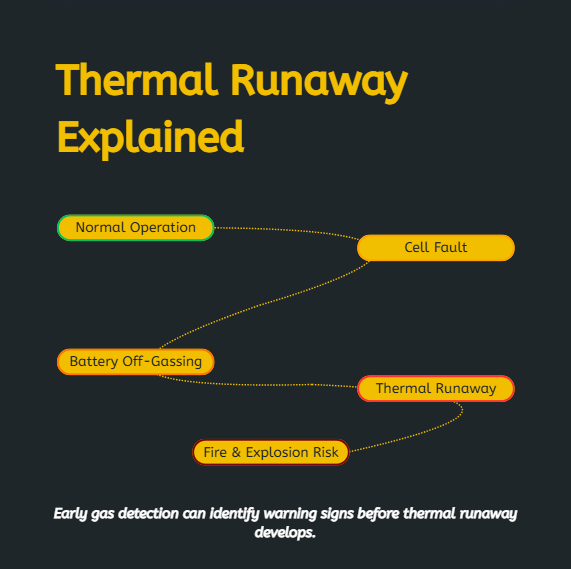
Thermal runaway remains one of the most significant risks associated with lithium-ion battery systems. A fault within a single battery cell can cause temperatures to rise rapidly, potentially leading to the failure of neighbouring cells and resulting in fire or explosion.
High Rack and Cable Densities
AI infrastructure often requires densely packed server racks and extensive cabling networks. These environments can create concentrated heat loads and hidden pathways for smoke and fire to spread through cable trays, raised floors, and equipment voids.
Electrical and Power System Faults
Continuous high-load operation places increased demand on switchgear, transformers, UPS systems, and electrical distribution equipment. Equipment failure or electrical faults remain a significant potential source of ignition within data centre environments.
Gas Leak Risks in AI Data Centres
Battery Off-Gassing
Lithium-ion batteries can release gases during failure events before visible smoke or fire develops. Detecting these early warning signs can provide valuable time for investigation and intervention before conditions escalate.
Cooling System Leaks
The adoption of advanced cooling technologies increases the presence of refrigerants and cooling fluids throughout the facility. Leaks may present environmental, health, or operational risks depending on the systems being used.
Sulphur Hexafluoride (SF₆) Breakdown
Some electrical switchgear utilises sulphur hexafluoride (SF₆) for insulation. Under fault conditions, SF₆ can decompose into potentially hazardous by-products, making monitoring and maintenance essential.
Why Traditional Fire Protection Isn’t Always Enough
Traditional fire detection systems remain a vital part of data centre protection strategies. However, modern AI facilities present challenges that conventional smoke and heat detectors were not originally designed to address.
The high airflow rates created by cooling systems can dilute and redistribute smoke particles, potentially delaying detection. In some cases, smoke may be carried away from the source before reaching conventional detectors.
Similarly, increasing cable densities and hidden infrastructure spaces can make it difficult for ceiling-mounted detectors to identify low-energy smouldering events developing beneath raised floors or inside cable routes.
Battery-related hazards can present an additional challenge. Thermal runaway is often preceded by off gassing, where a failing battery begins releasing gases before any visible smoke or flame develops. Traditional fire detectors are generally not designed to identify these early indicators, meaning opportunities for early intervention could be missed.
High-density AI computing environments can also experience prolonged periods of overheating before ignition occurs. Thermal imaging technologies can help identify abnormal temperature increases and developing hotspots before they become a more significant fire risk.
For these reasons, many operators are adopting a layered approach that combines traditional fire protection with aspirating smoke detection, gas detection technologies, thermal monitoring, and continuous asset monitoring.

Building Resilient AI Infrastructure
As AI data centres continue to increase in size and power demand, resilience must be built into every stage of a facility’s design. Maintaining uptime remains critical, but ensuring the safe operation of increasingly complex power and battery systems is becoming equally important.
Fire and gas detection systems play a key role in helping operators identify abnormalities before they develop into larger incidents. A layered approach that combines early warning technologies, continuous monitoring, and effective risk management can significantly improve both safety and operational reliability.
Early Detection Within AI Data Centres
Early detection is essential within AI environments where even minor incidents can have significant financial and operational consequences.
Aspirating Smoke Detection (ASD) systems continuously sample air from protected areas and can detect very low concentrations of smoke particles, often providing earlier warning than conventional point detectors. This makes them particularly well suited to high-value environments such as data centres.
For battery storage and UPS applications, gas detection technologies can provide an additional layer of protection by identifying gases associated with the initial stages of lithium-ion battery failure. Detecting these warning signs before thermal runaway develops can provide operators with valuable time to investigate and implement mitigation measures.
Risk-Based Design and Classification
Building resilient facilities starts during the design phase. Data centres should be assessed using appropriate hazard classifications and fire protection strategies that reflect the increased power density, heat loads, and operational demands associated with AI workloads.
Involving specialist fire and gas detection engineers during the early stages of a project can help ensure that protection systems are integrated effectively rather than added later as a retrofit solution. This approach not only improves safety outcomes but can also reduce long-term project costs by avoiding expensive modifications after construction is complete.
How Protex Systems Supports Critical Infrastructure
As battery storage systems become increasingly common within AI data centres, having the right detection and monitoring technologies in place is essential. Early warning of potential hazards can provide operators with valuable time to investigate, respond, and minimise the impact of an incident.
At Protex Systems, we work with organisations across a range of critical infrastructure sectors, providing fire and gas detection solutions designed to support safe and reliable operations. From Battery Energy Storage Systems (BESS) to complex industrial environments, our focus is on helping organisations identify potential risks as early as possible through robust detection and monitoring technologies.
As AI continues to drive demand for larger, more energy-intensive facilities, ensuring that safety evolves alongside technological advancement will remain a key consideration. By combining resilient infrastructure with effective detection systems, operators can help safeguard both their assets and the continuity of the services they provide.

